
Free tool
Homelab UPS runtime & sizing calculator
Find the smallest UPS that keeps your lab up long enough to shut down cleanly. Add what plugs into it, set how many minutes you need, and see which APC and CyberPower models fit.
Add what plugs into the UPS
Typical is what it draws on an ordinary day, and sets the runtime. Peak is the most it pulls, and sets the size. A plug-in power meter gives you both.
Already used the power cost calculator? Bring your device list across instead of typing it again.
Proxmox host
70 W peak
70 W
With four spinning drives
60 W peak
60 W
OPNsense mini PC
20 W peak
20 W
Includes two access points
50 W peak
50 W
From your ISP
12 W peak
12 W
Set what you need from it
Most labs only need enough time for the UPS to tell every machine to shut down. Ten minutes covers that with room to spare.
Time for a clean shutdown
So the UPS never runs flat out
Older batteries hold less
Only converts watts to VA
Output wave
Form factor
Your NAS and mini PCs likely have active PFC power supplies. On a simulated sine UPS they can switch off the moment the power goes, so pure sine is on by default.
UPS models for this load
Sorted by the smallest unit that covers your runtime. Runtime is at your typical draw of 118 W with a 2-year-old battery.
| Model | Rating | Output | Peak load | Runtime | Spare | Fit | Price |
|---|---|---|---|---|---|---|---|
| CyberPower CP850PFCLCDTower | 850 VA / 510 W | Pure sine | 42% | ≈ 21 min | +11 min | Best fit | Check pricefor the CyberPower CP850PFCLCD on Amazon (opens in a new tab) |
| CyberPower PR750LCDTower | 750 VA / 525 W | Pure sine | 40% | ≈ 32 min | +22 min | Fits | Check pricefor the CyberPower PR750LCD on Amazon (opens in a new tab) |
| APC BR1000MSTower | 1000 VA / 600 W | Pure sine | 35% | ≈ 30 min | +20 min | Fits | Check pricefor the APC BR1000MS on Amazon (opens in a new tab) |
| CyberPower CP1000PFCLCDTower | 1000 VA / 600 W | Pure sine | 35% | ≈ 21 min | +11 min | Fits | Check pricefor the CyberPower CP1000PFCLCD on Amazon (opens in a new tab) |
| CyberPower OR1000PFCRT2U2U rack or tower | 1000 VA / 700 W | Pure sine | 30% | ≈ 52 min | +42 min | Fits | Check pricefor the CyberPower OR1000PFCRT2U on Amazon (opens in a new tab) |
| CyberPower CP1350PFCLCDTower | 1350 VA / 880 W | Pure sine | 24% | ≈ 41 min | +31 min | Fits | Check pricefor the CyberPower CP1350PFCLCD on Amazon (opens in a new tab) |
| APC SMC1500-2UC2U rack mount | 1500 VA / 900 W | Pure sine | 24% | ≈ 89 min | +79 min | Fits | Check pricefor the APC SMC1500-2UC on Amazon (opens in a new tab) |
| APC SMC1500Tower | 1500 VA / 900 W | Pure sine | 24% | ≈ 64 min | +54 min | Fits | Check pricefor the APC SMC1500 on Amazon (opens in a new tab) |
| APC BR1500MS2Tower | 1500 VA / 900 W | Pure sine | 24% | ≈ 52 min | +42 min | Fits | Check pricefor the APC BR1500MS2 on Amazon (opens in a new tab) |
| APC SMT1500RM2UC2U rack mount | 1500 VA / 1000 W | Pure sine | 21% | ≈ 2 h 16 min | +2 h 6 min | Fits | Check pricefor the APC SMT1500RM2UC on Amazon (opens in a new tab) |
| CyberPower CP1500PFCLCDTower | 1500 VA / 1000 W | Pure sine | 21% | ≈ 47 min | +37 min | Fits | Check pricefor the CyberPower CP1500PFCLCD on Amazon (opens in a new tab) |
| CyberPower OR1500PFCRT2U2U rack or tower | 1500 VA / 1050 W | Pure sine | 20% | ≈ 1 h 32 min | +82 min | Fits | Check pricefor the CyberPower OR1500PFCRT2U on Amazon (opens in a new tab) |
| CyberPower PR1500RT2U2U rack or tower | 1500 VA / 1500 W | Pure sine | 14% | ≈ 2 h 0 min | +1 h 50 min | Fits | Check pricefor the CyberPower PR1500RT2U on Amazon (opens in a new tab) |
| APC BE600M1Tower | 600 VA / 330 W | Simulated sine | 64% | ≈ 16 min | +6 min | Not for PFC | Check pricefor the APC BE600M1 on Amazon (opens in a new tab) |
| APC BE850G2Tower | 850 VA / 450 W | Simulated sine | 47% | ≈ 24 min | +14 min | Not for PFC | Check pricefor the APC BE850G2 on Amazon (opens in a new tab) |
| CyberPower EC850LCDTower | 850 VA / 510 W | Simulated sine | 42% | ≈ 15 min | +5 min | Not for PFC | Check pricefor the CyberPower EC850LCD on Amazon (opens in a new tab) |
| CyberPower CP1500AVRLCD3Tower | 1500 VA / 900 W | Simulated sine | 24% | ≈ 58 min | +48 min | Not for PFC | Check pricefor the CyberPower CP1500AVRLCD3 on Amazon (opens in a new tab) |
| APC BX1500MTower | 1500 VA / 900 W | Simulated sine | 24% | ≈ 48 min | +38 min | Not for PFC | Check pricefor the APC BX1500M on Amazon (opens in a new tab) |
| APC BN1500M2Tower | 1500 VA / 900 W | Simulated sine | 24% | ≈ 47 min | +37 min | Not for PFC | Check pricefor the APC BN1500M2 on Amazon (opens in a new tab) |
Runtimes are read from each maker’s published chart and cut by 15% for battery age. As an Amazon Associate we earn from qualifying purchases, at no extra cost to you.
Runtime drops fast as load rises
The CyberPower CP850PFCLCD from the table. Halve the load and you get more than twice the runtime, so keep the UPS for the machines that need it.
- New batteryFrom the maker’s runtime chart.
- After 2 yearsAbout 15% less, which is what you should plan on.
- What you needAnything above this line gets you a clean shutdown.
Homelab Planning Bundle
Now price the whole build
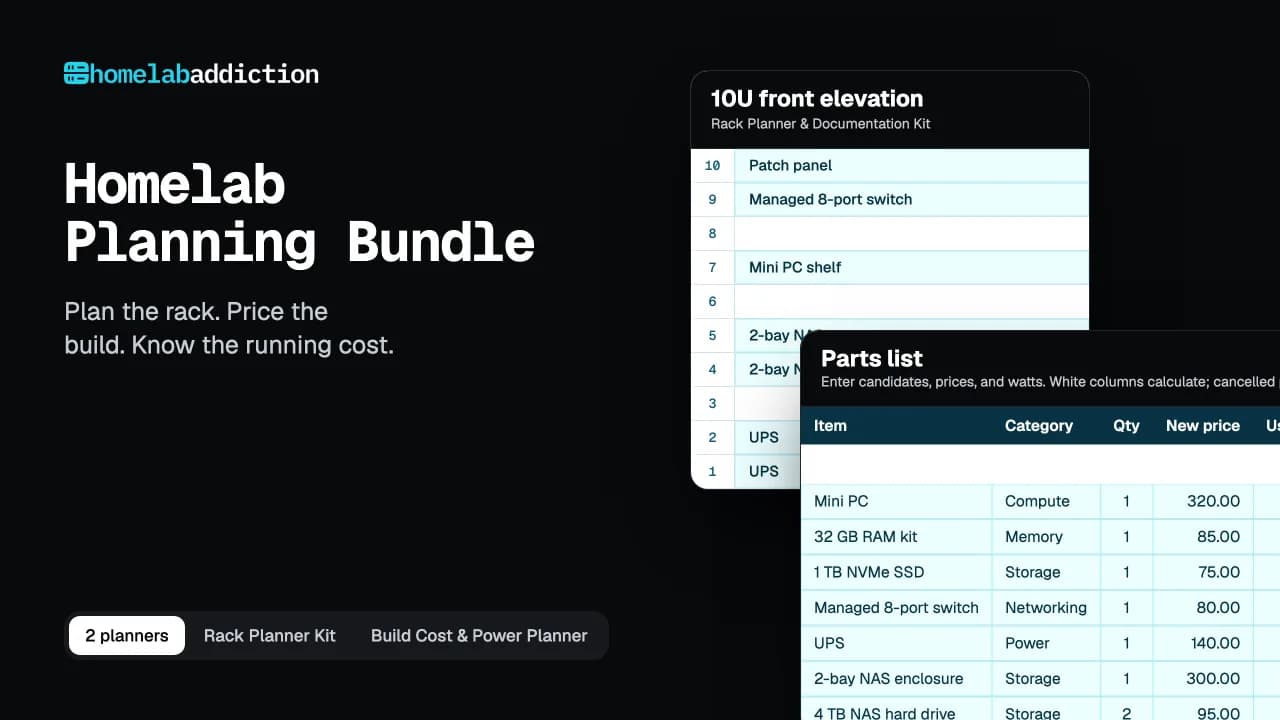
Two planners in one download. One works out what your lab will cost to buy and to run. The other maps where every part goes in the rack.
- Build Cost & Power Planner: Excel workbook with parts list, budget, power cost, and build phases
- Rack Planner & Documentation Kit: 17-page printable and fillable PDF
- Filled example build, so you can see every formula working
- Quick-start guide in A4 and US Letter
$19.99$27.98 bought separatelySave $7.99
Nothing hidden
How the numbers are calculated
Each line uses the example above, so you can check it by hand.
- Peak load
- qty × peak W, added up for every device70 + 60 + 20 + 50 + 12 = 212 W
- Minimum rating
- peak load × (1 + headroom)212 × 1.25 = 265 W
- Same rating in VA
- watts ÷ 0.6 power factor265 ÷ 0.6 = 442 VA
- Runtime
- maker’s runtime at your typical draw × battery age factor24.8 min at 118 W on the CP850PFCLCD × 0.85 = 21 min
- Time to spare
- runtime − the minutes you need21 min − 10 = 11 min
Before you buy one
What will bite you
01
VA is not watts
A 1500 VA UPS may only deliver 900 W. Size on the watt rating, which is printed separately on the spec sheet.
02
Active PFC needs pure sine
Many server and NAS power supplies switch off on battery when fed a simulated sine wave. Check yours before buying the cheap model.
03
Batteries fade
Expect 15–25% less runtime after two or three years, and plan to swap the battery every three to five.
04
Runtime only helps if you shut down
Set up NUT or apcupsd so the UPS tells your servers to power off, then pull the plug once to test it.
Questions
UPS calculator FAQ
Do I need a pure sine wave UPS?
If your server or NAS has an active PFC power supply, yes. Many of them switch off on battery when fed a simulated sine wave, which is exactly when you need them on. The calculator only recommends pure sine models unless you turn that off.
How many minutes of runtime do I need?
Enough for every machine to shut down on its own, plus a margin. Most labs finish in two to five minutes, so ten covers it with room to spare. Riding out long outages takes far more battery than a homelab UPS carries; a clean shutdown is the realistic goal.
Should the modem and PoE switch go on the UPS?
Yes, if you want remote access or monitoring to keep working during an outage, and both draw little. Put the modem, router and switch on the battery side; leave printers and monitors you don’t need on the surge-only outlets.
Where do the runtime figures come from?
From each maker’s published runtime chart: CyberPower’s on each product page and APC’s runtime graphs. Both are measured with new, fully charged batteries. Between the charted points the calculator interpolates along the curve, then takes off about 7.5% for every year of battery age.
Is anything I type saved or sent anywhere?
No. The calculator runs in your browser and your devices are never sent anywhere. The page records that the calculator was used, without the values you entered.
Newsletter
Get the next tested guide in your inbox
One email when a new guide or tool goes up. You can leave with one click.
Enter your email address to receive the Homelab Addiction newsletter.