
FTC disclosure: This article contains affiliate links. If you buy through them, HomelabAddiction may earn a commission at no extra cost to you.
Networking
OpenWrt vs OPNsense vs pfSense: Which Homelab Router OS Fits?
Compare OpenWrt vs OPNsense vs pfSense for a homelab, including routing, firewall features, hardware flexibility, management, and maintenance trade-offs.
HomelabAddiction Research Desk14 min read

Key Takeaways
- OPNsense is the best default pick for most homelabs because it balances advanced firewall features, frequent updates, strong WireGuard support, and a much cleaner day-to-day UI than pfSense.
- pfSense still makes sense if you want the deepest legacy documentation or you are already on Netgate hardware. It is not a bad platform. It is just a less attractive fresh install for most DIY homelabbers now.
- OpenWrt is the best low-power and reuse-what-you-already-own option when your main goal is routing, VLANs, basic VPN, and low overhead, not a giant security appliance feature stack.
- On modern hardware, all three can handle a normal gigabit homelab, but the moment you care about IDS/IPS, multi-WAN, deep reporting, or a bigger VLAN design, OpenWrt starts feeling like the lighter tool rather than the richer one.
- If you are buying an Intel N100 mini PC with 2.5GbE ports, OPNsense is the platform to consider first.
Documentation basis: This comparison is grounded in the pfSense documentation, the OPNsense documentation, the OpenWrt documentation, and the hardware-fit guidance already referenced in the article. No same-morning lab benchmark across all three platforms on one appliance is claimed here.
Short answer: Choose OPNsense for a full-featured x86 homelab firewall, OpenWrt for low-power routing and supported consumer hardware, and pfSense when its ecosystem or existing Netgate hardware is the deciding factor.
If the next decision is how to isolate servers, IoT devices, and management traffic after choosing the router OS, continue with the homelab network segmentation guide.
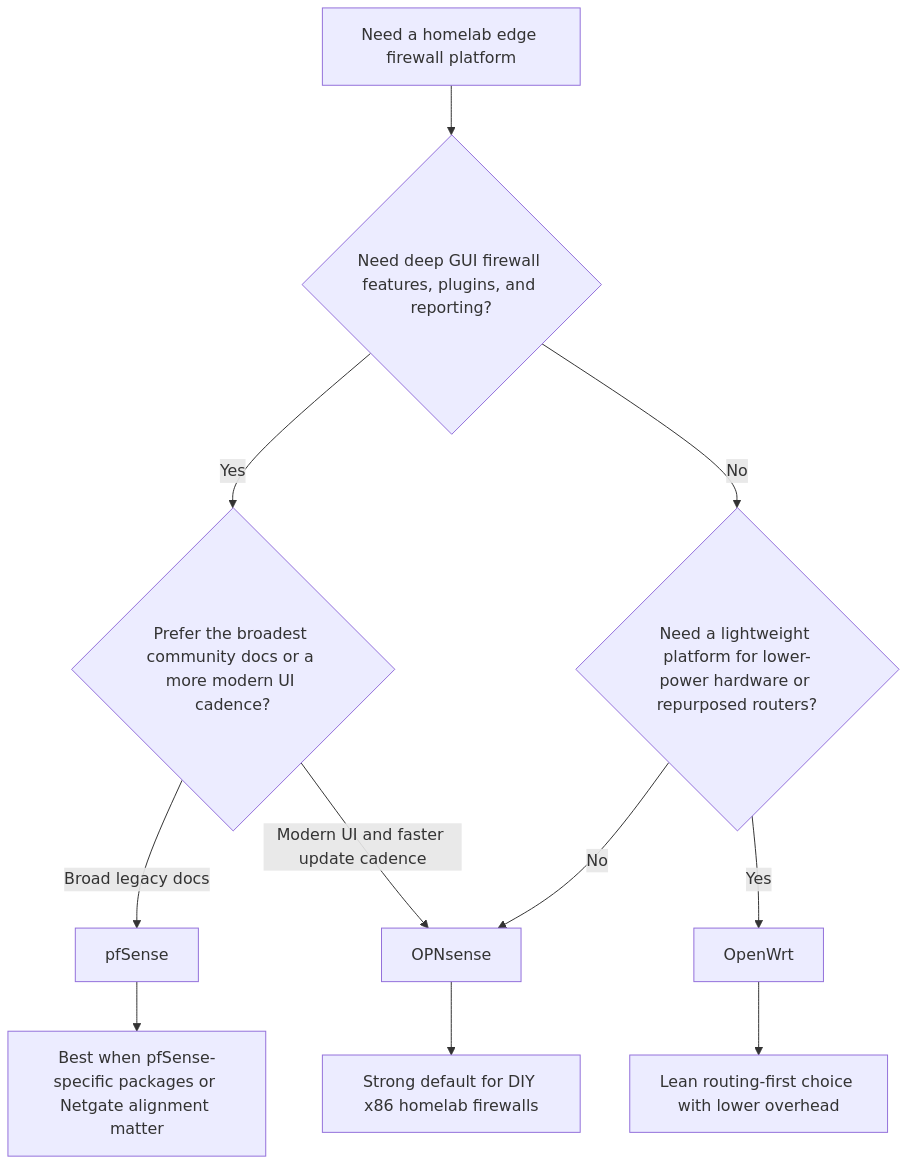
This page helps a homelab operator choose an edge firewall platform by matching the platform to the job: deep firewall and plugin features, a cleaner DIY x86 experience, or the lightest routing-first footprint on small hardware.
OPNsense is the best default when the homelab wants a feature-rich firewall on common mini-PC hardware without giving up update cadence or WireGuard support. pfSense remains relevant when pfSense-specific packages, legacy documentation, or Netgate alignment matter. OpenWrt fits lower-overhead routing and VLAN jobs where a full security-appliance stack would be more platform than the site needs.
The useful decision is not which brand “wins.” It is which operational model best matches the WAN edge, hardware budget, and firewall scope already planned for the homelab.
Planning the hardware around the firewall choice? The Home Lab Rack Planner helps you map where the edge box, switch, and UPS will fit before you buy. It is $14.99 normally, or $11.99 with code EARLY20 for early supporters. Limited to the first 50 purchases.
Recommended hardware for this kind of build
If you are shopping while reading, these are the three gear categories that fit this article best:
If you already know you are buying hardware for this firewall build, it is worth checking whether Coupert can surface a coupon or cashback offer before checkout. Coupert can help surface both while you shop.
- Fanless Intel N100 mini PC with 4x 2.5GbE - the sweet spot for OPNsense or pfSense builds
Recommended search link - Protectli-style firewall appliance - still a clean choice if you want a purpose-built box
Recommended search link - Managed 2.5GbE switch with VLAN support - if you are going beyond a flat network, this matters as much as the firewall OS
Recommended search link
Documentation basis and decision criteria
This comparison uses current official documentation plus published performance references that are directly relevant to homelab firewall buyers. The aim is to compare operational fit, hardware overhead, and feature depth without claiming one freshly run lab benchmark across all three platforms.
The most useful numbers came from:
transmission signup
article_topic // OpenWrt vs OPNsense vs pfSense
Don't leave without the setup notes.
Get practical homelab guides, failure logs, and beginner-friendly build notes in your inbox.
Enter your email address to receive the Homelab Addiction newsletter.
Weekly only. No spam. Unsubscribe anytime.
- Netgate's official pfSense documentation
- the official OPNsense documentation
- OpenWrt's official docs at openwrt.org
- Binary Impulse's multi-gig OPNsense tuning write-up
- René Mayrhofer's firewall throughput and power measurements across OPNsense and OpenWrt hardware classes
- OpenWrt community throughput and WireGuard dataset summaries
- current comparison pieces from WunderTech, PeopleAreGeek, pfSenseLab, and others
That is enough to answer the practical question most readers care about: which one fits my hardware, my power budget, and my feature needs without turning into another side project?
The quick comparison table
| Platform | Best for | Hardware style | Power / overhead profile | Advanced firewall depth | VPN story | Editorial view |
|---|---|---|---|---|---|---|
| OPNsense | Most homelabs | x86 mini PC, appliance, or VM | Moderate hardware footprint, rich software stack | Excellent | Excellent, especially WireGuard and strong plugin story | Best overall default |
| pfSense | Netgate users and people who value its legacy ecosystem | Netgate appliance, x86 mini PC, VM | Similar compute class to OPNsense | Excellent | Excellent, but less attractive fresh-start story than OPNsense | Strong, but no longer my default recommendation |
| OpenWrt | Low-power routing, repurposed hardware, simple edge builds | Consumer router, SBC, x86 | Lowest potential power draw, leanest footprint | Good, but not the same class as the other two | Good, depends heavily on hardware | Best when simplicity, watts, and hardware reuse matter most |
What each platform actually is
pfSense
pfSense is the old heavyweight in this category. It has the biggest accumulated knowledge base, a lot of old forum answers, a lot of YouTube history, and a reputation for being the thing advanced home users installed when consumer routers stopped being enough.
The catch in 2026 is that "pfSense" is not one perfectly clean story anymore. A lot of the gravity is around Netgate hardware and the pfSense Plus path. If you already own a Netgate box, that is not a problem. If you are building on your own hardware, it matters more.
OPNsense
OPNsense is the platform that now feels most aligned with how homelabbers actually build. It is still a serious firewall OS, but it is easier to navigate, more transparent in day-to-day project direction, and better at not making ordinary management work feel older than it needs to.
That matters when you are creating VLANs, touching aliases, moving WireGuard peers around, or iterating on the kind of rule sets that pair naturally with guides like our Homelab Firewall Rules.
OpenWrt
OpenWrt is the odd one here, and that is exactly why it belongs in the comparison.
If you only compare pfSense and OPNsense, you are assuming the reader needs a full firewall distro. A lot of people do not. Some people just need stable routing, VLANs, DNS tweaks, SQM, and a sensible VPN option on hardware that sips power and already exists in a drawer.
That is OpenWrt's lane. It is not trying to be a mini enterprise firewall first. It is trying to be a flexible network OS that happens to run on an enormous range of hardware.
Performance, throughput, and resource usage
This is where most comparison articles get vague. They say all three are "fast" and move on. That is not useful.
The first thing to understand
At plain gigabit routing and NAT, modern hardware matters more than distro choice.
FirewallCompare's 2026 comparison makes that point directly for pfSense and OPNsense, and the broader community data backs it up. If you install either pfSense or OPNsense on a decent Intel N100 box with good NICs, normal gigabit internet is not the hard part.
The harder part is what happens when you start layering real homelab behavior on top:
- PPPoE
- IDS/IPS
- multi-WAN
- VPN tunnels
- 2.5GbE switching
- deep traffic reporting
- virtualization overhead
That is where the platforms separate.
Published benchmark references that actually matter
| Scenario | Result | Why it matters |
|---|---|---|
| OPNsense in Proxmox, multi-gig WAN, Binary Impulse | roughly 2-3 Gbps out of the box, later tuned to full 6 Gbps | shows FreeBSD firewall platforms can need tuning before they stretch their legs at higher speeds |
| OPNsense forum user on older Protectli FW4 / J3060 | poor on-box testing and obvious CPU limits | shows older low-power hardware can be the bottleneck long before the software is |
| OPNsense forum user on Intel N100 + 4x i226-V | about 1100 down / 450 up, with strong bufferbloat result | shows modern budget x86 hardware is already enough for many real homelabs |
| René Mayrhofer power measurements | APU4d4 OPNsense 9-11W normal, Edge4Go OPNsense 11-14W, Turris Omnia 14-16W, VM overhead marginal on an already-running host | gives a much better real-world sense of hardware-class cost than generic feature charts |
| Notebookcheck OpenWrt hardware comparison | router SoC roughly 3-8W, Raspberry Pi class 5-10W, x86 mini PC 10-25W | highlights OpenWrt's biggest structural advantage: low-power flexibility |
What those numbers mean in practice
If your internet connection is 1 Gbps or below, all three can work well on the right hardware.
If you are on old dual-core appliance hardware, pfSense and OPNsense can become frustrating faster than people admit, especially under PPPoE or inspection-heavy workloads.
If you are on a current N100 or similar x86 mini PC, OPNsense and pfSense both become much more attractive because the box is cheap, quiet, and powerful enough to carry extras like WireGuard, VLAN routing, and heavier rule sets.
If your priority is lowest idle draw and minimum hardware fuss, OpenWrt remains hard to beat. That is particularly true if you do not need Suricata, advanced reporting, or a big plugin-based security stack.
Resource usage and management overhead
This is the part most buyers underestimate.
- OpenWrt has the smallest software personality. It can do a lot, but it generally asks less from the machine when your use case is straightforward.
- OPNsense carries more features and more visibility, which means more CPU and RAM appetite than OpenWrt but also a much more capable management surface.
- pfSense lands in roughly the same hardware class as OPNsense, but The user-facing experience can feel less rewarding unless there is a reason to stay in its ecosystem.
If your homelab edge is supposed to become a serious policy enforcement point, Spending 10-20W on an x86 mini PC for OPNsense is often more practical than pushing a smaller OpenWrt box beyond its limits. If the edge is supposed to be quiet, boring, and power-conscious, OpenWrt is the smarter answer.
Feature comparison that actually matters
| Feature | pfSense | OPNsense | OpenWrt |
|---|---|---|---|
| VLANs | Excellent | Excellent | Good to very good, depends on hardware and comfort level |
| Multi-WAN | Excellent | Excellent | Possible, but less polished for most users |
| IDS/IPS | Strong | Strong, and often better integrated for homelab use | Possible, but not why most people pick it |
| WireGuard | Good | Excellent | Good, hardware-sensitive |
| REST/API automation | Limited compared with OPNsense | Better | Varies by package/tooling |
| Runs well as VM | Yes | Yes | Possible, but less natural fit |
| Best on consumer router hardware | No | No | Yes |
| Best on fanless x86 mini PC | Yes | Yes | Yes, but usually not the best use of that hardware unless you want minimalism |
Pros and cons
pfSense pros
- huge legacy knowledge base
- familiar to a lot of admins
- strong on Netgate hardware
- still a very capable firewall and VPN platform
pfSense cons
- less attractive fresh-start story for DIY homelabbers than it used to be
- project direction feels more vendor-centered
- UI feels older and slower than OPNsense
- harder to recommend as the default when OPNsense exists
OPNsense pros
- best overall balance of capability and usability
- more modern management experience
- frequent updates and clearer momentum
- strong plugin ecosystem for homelab-relevant features
- excellent fit for Intel N100 firewall boxes
OPNsense cons
- still wants real hardware if you plan to push traffic and features hard
- can require tuning at multi-gig speeds
- more moving parts than a simple OpenWrt router build
OpenWrt pros
- lowest barrier to reusing supported hardware
- best power-efficiency ceiling
- great for routing-first and SQM-first setups
- flexible package ecosystem
- strongest choice when you do not need a full firewall appliance experience
OpenWrt cons
- weaker fit for readers who want a full security dashboard and appliance-style workflow
- advanced firewall/reporting scenarios are less turnkey
- experience varies more by hardware platform than the other two
- easier to outgrow if your homelab keeps getting segmented and complicated
From the lab

Who should pick pfSense
Pick pfSense if:
- you already run Netgate hardware
- you have muscle memory for pfSense and do not want to relearn your edge stack
- you value the sheer amount of existing guides, forum history, and old troubleshooting breadcrumbs
- you want a conservative, proven platform and are less concerned with UI polish
This is also the answer if you inherited a working pfSense box and it is doing its job. A healthy existing setup does not need to be replaced solely for a different interface.
Who should pick OPNsense
Pick OPNsense if:
- you are starting fresh on a mini PC or dedicated appliance
- you want VLANs, WireGuard, better reporting, and room to grow
- you care about updates and project transparency
- you want something powerful enough to pair with articles like our DHCP guide, our WireGuard vs OpenVPN comparison, and a proper segmented switch design like the one in our managed switch comparison
This is the best choice for the reader whose homelab is no longer one flat LAN and a prayer.
Who should pick OpenWrt
Pick OpenWrt if:
- you already own supported router hardware and want to squeeze real life out of it
- power draw matters more than feature sprawl
- you want strong routing, SQM, and decent VPN options without running a bigger firewall stack
- your network is modest in scale and you are not chasing enterprise-style visibility at the edge
OpenWrt also pairs nicely with the kind of network where the access layer matters more than the firewall OS itself. If your next upgrades are better APs and VLAN-capable switching, articles like our Wi-Fi AP comparison may move the needle more than switching firewall distros.
Editorial verdict
For most HomelabAddiction readers, the strongest default recommendation is OPNsense.
Here is why:
- it does the advanced homelab firewall job better than OpenWrt
- it feels more current and easier to live with than pfSense
- it scales from a simple VLAN build to a serious edge box without feeling like the wrong tool halfway through
- it matches the cheap-and-capable hardware market extremely well, especially fanless N100 mini PCs
The category winners
- Best overall: OPNsense
- Best if you already own Netgate hardware: pfSense
- Best ultra-low-power choice: OpenWrt
- Best for a new x86 mini PC homelab firewall: OPNsense
- Best if you want the biggest old knowledge base: pfSense
- Best if you want to reuse an existing supported router: OpenWrt
If your lab is just getting started and you want the most room to grow without making the edge unnecessarily complicated, OPNsense is the safest recommendation.
OpenWrt vs OPNsense: which one fits better?
OpenWrt usually fits better when the job is lightweight routing, better Wi-Fi hardware support, or a smaller footprint on limited hardware. OPNsense fits better when you want the fuller firewall appliance model, a richer web UI for policy work, and a broader security-tooling path on x86 hardware.
pfSense vs OpenWrt: the practical split
If the homelab edge needs deeper firewall features, package-driven expansion, and a more appliance-like workflow, pfSense still makes more sense than OpenWrt. If the box is really acting more like a router with VLANs, basic firewall rules, and constrained hardware, OpenWrt can be the cleaner answer.
Is OpenWrt better than OPNsense for Wi-Fi routers?
Often yes, especially when wireless support on the hardware matters more than running a heavier firewall stack. That does not make OpenWrt universally better. It means the platform match changes when the box is expected to be both router and access-point platform.
FAQ
Is OPNsense faster than pfSense?
On equivalent modern hardware, not in a way that matters for ordinary gigabit routing. The more important differences are UI, update cadence, plugin integration, and project direction. Hardware quality matters more than distro choice until you start pushing specialized workloads.
Is OpenWrt enough for a serious homelab?
Sometimes, yes. If your definition of serious means VLANs, decent routing, SQM, and a VPN tunnel, OpenWrt can absolutely be enough. If you want IDS/IPS, richer traffic analysis, more appliance-style management, and a bigger security stack, OPNsense or pfSense makes more sense.
Should I run my firewall in Proxmox?
You can, and many people do. It is especially common with OPNsense and pfSense. Just remember that your hypervisor becomes part of the reliability story. If your Proxmox host is down, your network edge is down too.
Which one is best for WireGuard?
For most homelabbers, OPNsense is the best all-around WireGuard platform in this comparison because it combines strong support with a more complete firewall workflow. OpenWrt can also be excellent for WireGuard, but hardware choice matters a lot more there.
What hardware should I buy for a new homelab firewall in 2026?
For most people, a fanless Intel N100 mini PC with multiple 2.5GbE ports is the sweet spot. It gives pfSense or OPNsense enough headroom for growth without dragging server-class noise and power draw into the rack.
Final answer
If you want one recommendation you can install and not regret six months later, run OPNsense.
If you have a strong reason to stay in the pfSense world, it is still a valid choice. If you want the smallest, leanest, lowest-power edge and your needs are more routing-centric than firewall-centric, OpenWrt is still one of the smartest pieces of software in the homelab world.
But for the average reader building a segmented, VPN-aware, mini-PC-powered homelab in 2026, OPNsense is the one to consider first.
transmission signupstatus: open channel
article_topic // OpenWrt vs OPNsense vs pfSense
Start building a smarter homelab.
Join readers learning Proxmox, networking, storage, backups, and self-hosting without breaking everything.
Enter your email address to receive the Homelab Addiction newsletter.
Beginner-friendly
No gatekeeping. Just clear, actionable guides.
1 useful email / week
Practical tips, real-world setups, and lessons learned.
Zero hype, practical only
What works, what breaks, and how to fix it.
Reply to any email with what you're building.
I read and reply to as many as I can.
— The Homelab Addiction Operator
support // the lab
Found this guide useful?
If it saved you time or a rebuild, you can support more practical homelab guides.