
Disclosure: This article contains affiliate links. If you buy through them, HomelabAddiction may earn a commission at no extra cost to you. We only recommend gear that fits a practical beginner homelab.
Self-Hosting
What Is a Homelab? Meaning, Uses, and How to Start Small
Learn what a homelab is, what a home lab is used for, what a homelab server does, and how to start small with one safe machine.
HomelabAddiction Research Desk13 min read

A homelab is a practice environment for learning servers, networking, storage, and self-hosted apps without risking the machine you rely on every day.
This page helps beginners decide whether building a homelab is worthwhile and how small they can start by grounding the answer in documented platforms such as Proxmox VE, Docker, and Jellyfin.
What is a homelab used for?
Most people use a homelab to learn Linux, run self-hosted apps, test networking changes, practice backups, and build a safer remote-access setup before touching devices that matter.
That is why queries like what is a homelab used for, what is a home lab, and what is a homelab server all lead back to the same core idea: a small, reusable environment for learning and running services at home without betting everything on one production machine.
What is a homelab server?
A homelab server is simply one machine inside the homelab that hosts services, containers, or virtual machines. It does not need to be loud rack gear. For many beginners, it is one quiet mini PC or an older desktop they can reinstall without stress.
How this page is framed: definitions and setup guidance in this article are based on the official product overviews for Proxmox VE, Docker, and Jellyfin. No hands-on benchmarking or personal lab claims are made here.
Key takeaways
- A homelab is a safe place to learn infrastructure by doing, not by only reading docs
- The best first homelab in 2026 is usually a quiet used mini PC, a cheap SSD, and one useful project
- New homelab strategy: start with one service you actually need, then add containers, backups, monitoring, and segmentation in layers
- Treat your lab as disposable and documented, not as a fragile snowflake server
- Start local-only first, then add remote access through a VPN before exposing anything publicly
- A beginner-friendly starter stack often looks like Linux or Proxmox, Docker, Tailscale, backups, and one dashboard or self-hosted app
What is a homelab?
A homelab is a small environment you run at home to experiment with the same ideas used in real servers and networks.
Think of it as a workshop for infrastructure.
Instead of learning only in theory, you can actually install Linux, spin up a VM, break something, restore it, and understand what happened. That practical feedback loop is why homelabs are so valuable.
A basic homelab usually includes:
- One or more machines you can reinstall without panic
- A home network connection, ideally Ethernet
- Software for services, containers, or virtual machines
- A simple backup plan
- Basic security habits like updates, strong passwords, and controlled remote access
What a homelab is not:
- It is not required to be a rack full of loud enterprise gear
- It is not only for IT professionals
- It is not a single fixed architecture that everyone must copy
- It is not supposed to break your main laptop or your family Wi-Fi
The real goal is controlled learning.
Why people build homelabs
People usually start a homelab for one of four reasons:
- Learning - Linux, networking, Docker, virtualization, security, automation
- Self-hosting - media servers, file sync, dashboards, backups, password managers, home automation
- Career growth - real hands-on experience with systems and troubleshooting
- Control and privacy - running your own services instead of depending entirely on third parties
That is also why homelabs stick. Once your first useful service works, the lab stops feeling like a toy.
The smarter 2026 homelab strategy
A lot of beginner advice still sounds like this: buy hardware first, install everything, then figure it out later.
That is the wrong order.
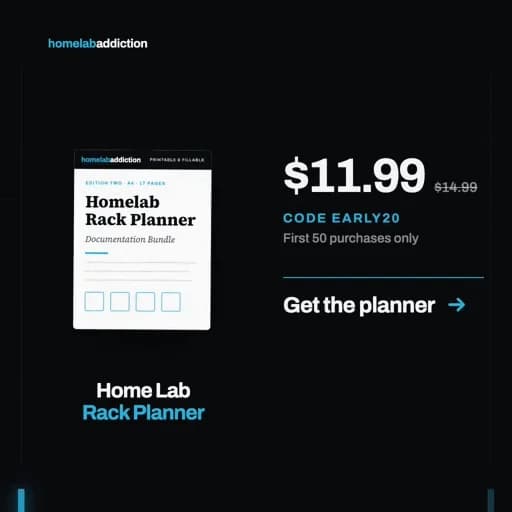
New in the store: If your first lab is heading toward a rack build, the Home Lab Rack Planner helps you map U space, device depth, power, and cable runs before you buy shelves or rails. It is $11.99 with code EARLY20 instead of $14.99, limited to the first 50 purchases.
A better 2026 strategy is:
- Start with one useful outcome
- Choose hardware only good enough for that outcome
- Run it locally first
- Add containers or VMs for clean isolation
- Add backups before adding more complexity
- Add monitoring so you can see what is happening
- Add network segmentation and public exposure only when you can explain why
This strategy works better because it reduces wasted spending, burnout, and the classic problem of building a pile of half-maintained services.
transmission signup
article_topic // What Is a Homelab? Meaning, Uses, and How to Start Small
Don't leave without the setup notes.
Get practical homelab guides, failure logs, and beginner-friendly build notes in your inbox.
Enter your email address to receive the Homelab Addiction newsletter.
Weekly only. No spam. Unsubscribe anytime.
Good first outcomes
Pick one of these:
- Learn Linux over SSH
- Run Pi-hole for network-wide ad blocking
- Build a media server and compare Jellyfin vs Plex vs Emby
- Start with a beginner self-hosting plan from What to Self-Host First
- Build a simple reverse proxy stack and compare Nginx Proxy Manager vs Caddy vs Traefik
- Learn safer remote access with Cloudflare Tunnel vs VPN vs Port Forwarding
If you finish one of those, you are already doing homelabbing the right way.
What you can actually do with a homelab
Here are beginner projects that matter in real life.
1. Learn Linux without fear
A spare box lets you learn SSH, packages, systemd, permissions, logs, and updates without risking your main device.
2. Run containers
Docker is the entry point for a huge percentage of modern self-hosting. In a homelab you can learn what containers are, how volumes work, why ports matter, and how to keep apps isolated.
Docker's own primer on what a container is is still worth reading if you are new.
3. Test virtualization with Proxmox
If you want multiple isolated environments on one box, Proxmox is one of the most practical beginner-friendly hypervisors because it handles VMs and containers in one interface. The Proxmox VE overview is the official starting point.
4. Build your own file and backup workflows
A homelab is where many people finally learn the difference between storage and backup. A shared folder is useful. A tested restore process is what actually protects you.
5. Improve your home network
You can learn guest networks, DNS filtering, VLANs, reverse proxies, and VPN remote access in a lower-risk environment than learning directly on production systems.
6. Create a self-hosted services stack
Once you understand the basics, your lab can host tools you use every day like dashboards, note-taking tools, media services, automation, and file sync.
What hardware do you need to start?
Much less than most YouTube setups suggest.
Best beginner options
| Option | Best for | Pros | Trade-offs |
|---|---|---|---|
| Old laptop or desktop | Cheapest start | Free or nearly free, great for Linux basics | More power draw, older drives, limited expansion |
| Used mini PC | Best beginner balance | Quiet, low power, compact, great for Docker and light Proxmox use | Limited internal expansion |
| Small custom server | Growth path | More RAM, more storage, better virtualization headroom | Costs rise fast |
| Raspberry Pi or similar ARM board | Specific lightweight projects | Tiny power draw, fun for DNS or simple services | Can be limiting for storage, virtualization, and app compatibility |
For most beginners in 2026, a used mini PC + SSD + Ethernet is still the sweet spot.
Minimum practical specs
A decent starter box looks like:
- 4 cores or better
- 8 GB RAM minimum
- 16 GB RAM preferred if you want several containers or a few VMs
- SSD storage, because old spinning disks make everything feel worse
- Gigabit Ethernet
If your first plan is mostly Docker, you do not need enterprise hardware. If your plan is multiple VMs, heavier storage, or AI experiments, you will want more RAM and faster storage sooner.
Beginner gear worth looking at
These are safe, broad recommendations rather than overly specific SKUs. They fit the majority of beginner homelab setups.
1. Used mini PC for your first server
A used Intel mini PC with 8th-gen or newer CPUs is a great first host for Linux, Docker, and light Proxmox work.
2. SATA or NVMe SSD for the OS and containers
An SSD makes your first homelab feel dramatically better than an old HDD.
3. 2.5GbE unmanaged switch
If you know you will expand into NAS, backup traffic, or multiple hosts, a simple 2.5GbE switch gives you room to grow without overcomplicating things.
4. UPS battery backup
A small UPS saves you from filesystem corruption and annoying outages. This is one of the least exciting but highest-value homelab upgrades.
5. NAS-grade hard drives for backup or media storage
If your lab grows into file storage, media, or backups, separate bulk drives make more sense than stuffing everything onto the OS disk.
These links are not there to push spending. They are there to shorten research time for people who already know they want a practical starter setup.
Software paths: what should you install first?
There are three common starting styles.
Option 1. Linux first
Best if your main goal is learning system administration, SSH, package management, and Docker.
Option 2. Linux plus Docker
Best if your goal is running useful apps quickly while learning how modern self-hosted services are deployed.
Option 3. Proxmox first
Best if you want to learn virtualization, test multiple operating systems, or keep workloads more separated from the beginning.
A common smart path is:
- Start with Linux on one machine
- Add Docker for apps
- Add Tailscale or WireGuard for remote access
- Add Proxmox later when you actually want multiple isolated machines
The core concepts worth understanding early
Private IPs and NAT
Most homelabs live on private IP ranges behind a router. That is one reason they are safer by default. RFC1918 defines these ranges officially in the RFC1918 standard.
VMs vs containers
- VMs give each workload a full operating system
- Containers share the host kernel and are lighter to run
Containers are usually easier for your first handful of services. VMs become useful when you want stronger isolation, different operating systems, or cleaner testing environments.
Treat your lab as disposable
This is one of the best strategies you can adopt early.
If a server feels too precious to reinstall, your learning slows down. Good notes, Compose files, backups, and documented steps are what make a lab resilient.
From the lab
Common beginner mistakes
Trying to do too much at once
The fix: one useful outcome at a time.
Buying hardware for an imaginary future
The fix: buy for the next 30 to 90 days of projects, not for a fantasy end-state.
Running everything with no backup plan
The fix: use a simple 3-2-1 mindset early. Backblaze's write-up on the 3-2-1 backup strategy is still a good plain-English reference.
Exposing services too early
The fix: run local-only first. When you need remote access, start with a VPN.
Building undocumented snowflake systems
The fix: keep a README for each service, write down ports, volumes, passwords location, and restore steps.
Safety basics that matter more than extra hardware
A better server does not automatically make a better homelab. Better habits do.
Start local-only
Do not rush into public exposure. Most beginners should keep services reachable only on the LAN until they understand what they are running.
Use VPN-first remote access
If you need access while away from home, start with WireGuard or Tailscale before you think about port forwarding.
Update regularly
Unpatched systems are a much more common problem than ultra-sophisticated attacks.
Use strong, unique passwords
A password manager is one of the highest ROI tools in a self-hosted setup.
Keep your install list small
Every extra service is something else to maintain, patch, monitor, and back up.
If you want a deeper breakdown of safe exposure trade-offs, read Cloudflare Tunnel vs VPN vs Port Forwarding.
A realistic first homelab roadmap
If you want a practical plan, follow this sequence:
Phase 1: one box, one goal
- Install Linux on a spare machine or mini PC
- Learn SSH and package updates
- Run one useful service
Phase 2: add containers
- Install Docker
- Run a second service in Compose
- Learn volumes, ports, and logs
Phase 3: add backup and monitoring
- Back up configs and important data
- Add uptime monitoring or a simple dashboard
- Test restoring something small
Phase 4: add cleaner isolation
- Try Proxmox or separate workloads more deliberately
- Split services into containers or VMs based on risk and complexity
- Add a guest network or VLANs if you are ready
Phase 5: expose only what you understand
- Use VPN-first access
- Put public services behind a reverse proxy if truly needed
- Keep admin panels private whenever possible
That roadmap produces a useful lab faster than trying to build a perfect setup in week one.
So, what is the point of a homelab?
A homelab gives you a low-stakes place to become competent.
You stop guessing how servers work because you start operating one.
You stop treating networking, Docker, DNS, backups, and Linux as abstract topics because you see the trade-offs in your own environment.
And over time, the lab often turns into something genuinely useful: your media server, your backup target, your DNS filter, your VPN endpoint, your automation hub, or your learning platform for the next role you want.
That is why the best homelab is not the biggest one. It is the one you can understand, maintain, recover, and keep using.
What to learn next
If this article helped you understand the concept, these are the best next reads on the site:
- Start Here
- Homelab Basics
- What to Self-Host First
- Jellyfin vs Plex vs Emby
- Nginx Proxy Manager vs Caddy vs Traefik
- The Ultimate Homelab Guide - a deeper resource covering homelab planning, hardware, networking, storage, virtualization, and project ideas.
FAQ
Do I need to work in IT to build a homelab?
No. A homelab is one of the best ways to learn by doing, even if you are starting from zero. You can begin with simple web interfaces and grow into Linux commands as you go.
What is the best first homelab project?
The best first project is something you will actually use. Pi-hole, a media server, a simple Linux box with SSH, or one Docker-based app are all strong starting points.
Is a homelab expensive?
It does not have to be. Many great beginner homelabs start with existing hardware or a used mini PC. Costs rise when you chase more storage, more VMs, faster networking, or quieter premium gear.
Should I start with Docker or Proxmox?
If you want quick wins and useful apps, start with Linux plus Docker. If your main goal is learning virtualization and keeping multiple environments isolated, Proxmox is a great next step.
Is a file server the same thing as a backup?
No. A file server helps you store and share data. A backup means you can restore that data after deletion, corruption, hardware failure, or ransomware.
What is the safest way to access a homelab remotely?
For most beginners, a VPN-first approach with WireGuard or Tailscale is the safest default. It avoids exposing extra services directly to the public internet.
Is one computer enough for a homelab?
Yes. One machine is enough for a real homelab if you can reinstall it, document it, and use it to learn one clear workflow such as Docker, backups, or virtualization.
What is the difference between a homelab and a home server?
A home server is the machine doing the work. A homelab is the broader practice environment around it, including experimentation, network design, backups, and recovery habits.
Sources and verification
Last verified: 2026-07-23. This article was reviewed against the primary sources listed below. Unsupported first-person testing claims were removed unless they were backed by cited vendor material.
transmission signupstatus: open channel
article_topic // What Is a Homelab? Meaning, Uses, and How to Start Small
Start building a smarter homelab.
Join readers learning Proxmox, networking, storage, backups, and self-hosting without breaking everything.
Enter your email address to receive the Homelab Addiction newsletter.
Beginner-friendly
No gatekeeping. Just clear, actionable guides.
1 useful email / week
Practical tips, real-world setups, and lessons learned.
Zero hype, practical only
What works, what breaks, and how to fix it.
Reply to any email with what you're building.
I read and reply to as many as I can.
— The Homelab Addiction Operator
support // the lab
Found this guide useful?
If it saved you time or a rebuild, you can support more practical homelab guides.