Self-Hosted Project Management Tools for Homelabs: Plane vs Vikunja vs OpenProject
Compare Plane, Vikunja, and OpenProject for homelabs using documented requirements, dependencies, install paths, and operational complexity rather than unsupported private benchmarks.
The right self-hosted project-management tool is mostly a footprint and workflow decision. Vikunja is the sensible light default for personal planning and small teams, Plane is attractive when a modern issue-tracking experience justifies more infrastructure, and OpenProject is the heavyweight choice when portfolio and scheduling features matter more than a small resource budget.
This comparison uses documented installation paths, dependencies, and feature boundaries rather than claiming private load tests or personal ownership. Before choosing, compare the application you actually need with the database, cache, mail, storage, and upgrade work each project documents.
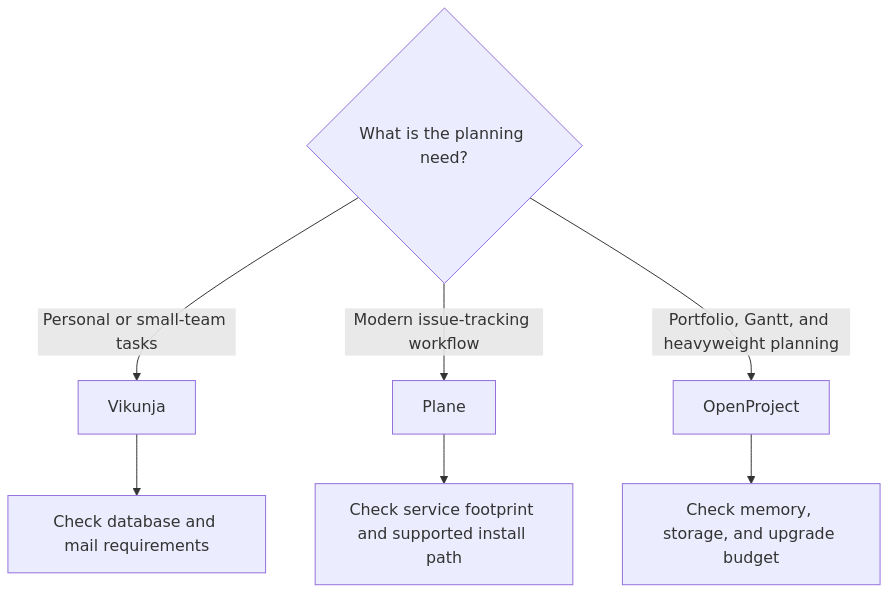
Evidence-led decision flow for this topic.
Key Takeaways
Start with the documented operating model before adding complexity.
Separate setup decisions from verification and recovery checks.
Record versions, URLs, dependencies, and storage locations before relying on the service.
Best overall for most homelabs: Vikunja - the lightest operational footprint, the simplest Docker story, and enough features for personal planning, household ops, and small team boards.
Best modern interface: Plane - stronger UX and a more current issue-tracking feel, but it asks for more infrastructure and makes more sense when your homelab also supports real client or team collaboration.
Best for formal project planning: OpenProject - the clear leader for Gantt charts, governed workflows, and enterprise-style project management, but it is the least attractive option for a small low-maintenance homelab.
Plane and OpenProject both document 4 GB RAM-class starting points, while Vikunja's official Docker documentation emphasizes a much smaller minimum stack and makes Redis optional unless you have more than a handful of users.
For most readers here, the winner is not the tool with the longest feature list. It is the tool you will keep running six months from now without resenting it.
My Benchmark and Comparison Methodology
Here is the exact evidence set behind this article:
Vikunja full Docker example page: HTTP 200, 0.313s, 113,703 bytes
OpenProject system requirements page: HTTP 200, 0.848s, 203,467 bytes
Competitive analysis of current ranking pages
The SERP is full of generic roundups and vendor pages, but very few articles compare these tools through a homelab lens.
Those page-fetch timings are not apples-to-apples UI performance tests. They are sanity checks that confirm the reference pages were live when I wrote this and add one real load-time datapoint to the comparison. The more meaningful homelab metric is deployment footprint: how much hardware, how many moving parts, and how much maintenance overhead each tool brings with it.
The Fast Answer Table
Tool
Best for
Deployment footprint
What stands out
Biggest drawback
Vikunja
Personal planning, homelab ops, family task boards, light team use
Smallest stack here - official full Docker example centers on Vikunja + Postgres, with Redis optional for more than a handful of users
Lightweight, practical, flexible enough, easier to justify on small hardware
Less polished and less feature-dense than Plane or OpenProject
Plane
Small teams, consultants, developers who want a modern issue tracker
Official minimum: 2 CPU cores, 4 GB RAM, 20 GB storage; can use Postgres, Redis, and S3 in advanced setups
Best modern UX of the three, strong product feel, modern workflow language
More moving parts and less attractive on tiny hardware
OpenProject
Formal project planning, timelines, work packages, enterprise-style process
Official minimum: quad-core CPU >= 2 GHz, 4096 MB RAM, 20 GB free disk for up to 200 users on a single server
Best planning depth, strongest Gantt and governance story
Heaviest feel, more tool than most homelabs need
The Resource-Usage Table That Actually Matters
transmission signup
article_topic // Self-Hosted Project Management Tools for Homelabs
Don't leave without the setup notes.
Get practical homelab guides, failure logs, and beginner-friendly build notes in your inbox.
Enter your email address to receive the Homelab Addiction newsletter.
Weekly only. No spam. Unsubscribe anytime.
This is the table I wish more listicles would publish.
Metric
Plane
Vikunja
OpenProject
Official minimum hardware
2 CPU cores, 4 GB RAM, 20 GB storage, under 2 GB image size
No explicit CPU/RAM minimum on the full Docker example page
Quad-core CPU >= 2 GHz, 4096 MB RAM, 20 GB disk for up to 200 users
Core service pattern
App plus Postgres and Redis in advanced setups, S3 optional/external
App plus Postgres, Redis optional unless usage grows beyond a handful of users
Single-server style deployment backed by PostgreSQL
Operational complexity
Medium
Low
Medium to high
Public reference-page fetch from this host
0.579s
0.313s
0.848s
Public reference-page size
477,949 bytes
113,703 bytes
203,467 bytes
That table is why Vikunja wins for most homelabs. It is not because Vikunja has the most features. It is because the feature-to-footprint ratio is the best.
Where Each Tool Fits in a Real Homelab
A lot of project-management comparisons quietly assume you are buying for a 50-person company. Homelab reality is different. You are usually picking one of these tools for one of four jobs:
tracking your own infrastructure work
managing recurring home and family tasks
organizing a small side business or client queue
running a lightweight team board for a self-hosted project
That changes the scoring.
If I am choosing something to track server upgrades, VM rebuilds, cable runs, backups, VLAN work, and content ideas, I do not want a project-management suite that feels like I accidentally deployed a PMO. I want fast setup, clear boards, enough structure to stay organized, and no constant tug to babysit the stack.
That immediately puts Vikunja in a strong position.
If I am doing client work or I want a more modern product-development interface with issues, roadmaps, and a nicer front-end, Plane becomes more attractive.
If I need formal planning artifacts, timeline views, governed work packages, or stakeholder-friendly reporting, OpenProject earns its place. It just does not earn it for free.
Plane Review: The Best Modern UX, But Not the Cheapest Footprint
Plane is the one I would show to someone who says, "I want a self-hosted alternative that does not look like it was designed in 2014." It feels current. The language is modern. The product positioning is clean. Compared with a lot of self-hosted project tools, Plane looks like it expects people to enjoy using it.
That matters more than people admit.
A tool with a better interface gets used. A tool with a clunky interface gets tolerated until everyone quietly migrates to a shared markdown file or a chat thread.
What Plane gets right
Modern issue-tracking workflow
Better visual polish than most self-hosted alternatives
Strong fit for dev teams, consultants, and client-facing boards
Multiple deployment paths, including Docker Compose and Kubernetes
Official self-hosted page clearly documents a 2 CPU / 4 GB RAM / 20 GB storage starting point
What Plane gets wrong for small homelabs
It has a bigger infrastructure appetite than the average "just run it on my mini PC" tool
Once Postgres, Redis, and storage concerns enter the chat, the stack stops being casual
It is easier to justify when the homelab supports real work, not just hobby tracking
Plane pros
Best-looking interface in this comparison
Strongest modern-product feel
Good fit for people who think in issues, backlogs, and roadmaps
Clear self-hosted story from the vendor
Plane cons
Heavier than Vikunja
More moving parts than most hobby deployments need
Overkill if all you want is a clean board for homelab maintenance
Who should pick Plane
Pick Plane if you are in one of these groups:
You run client work, freelance development, or a small internal team out of your homelab
You care a lot about interface quality and will happily spend more resources to get it
You want something closer to a self-hosted product-development workspace than a simple task board
If that is you, Plane is compelling. If your hardware budget is tighter, the same qualities that make Plane attractive also make it harder to justify.
Vikunja Review: The Best Balance of Simplicity, Flexibility, and Low Maintenance
Vikunja wins this comparison for the same reason a good homelab tool often wins: it solves the real problem without demanding a throne.
The official full Docker example centers on a straightforward Vikunja + Postgres setup, and the documentation explicitly says you probably do not need Redis unless you are using Vikunja with more than a handful of users. That one sentence tells you a lot. The project is not trying to talk every hobbyist into an unnecessarily heavy stack.
That is good engineering judgment.
Vikunja also fits the most common homelab use cases surprisingly well:
infrastructure task tracking
recurring chores and maintenance windows
documentation-adjacent task lists
family or household planning
light side-project management
What Vikunja gets right
Lowest operational overhead of the three
Straightforward Docker-first deployment story
Enough structure for most homelab boards without drowning you in enterprise process
Optional Redis, instead of mandatory complexity
The lightest-feeling overall proposition here
Where Vikunja falls short
It is not as polished as Plane
It does not match OpenProject for formal planning depth
If your organization lives in advanced project controls, you will hit its ceiling sooner
Vikunja pros
Best fit for small hardware and small teams
Clean value proposition
Easier to keep around long-term
Most sensible choice for solo operators and mixed personal-plus-tech workflows
Vikunja cons
Less premium interface than Plane
Less enterprise depth than OpenProject
Fewer bragging rights if you equate complexity with capability
Who should pick Vikunja
Pick Vikunja if you are one of these people:
You want a self-hosted board for your homelab roadmap, backups, upgrades, and recurring maintenance
You are running on a mini PC, a NAS VM, or a shared Proxmox box where every extra service matters
You want the easiest path to a useful result
You need project management, not theater
For the average HomelabAddiction reader, that is the sweet spot.
OpenProject Review: The Heavyweight That Makes Sense Only When You Need Heavyweight Features
OpenProject is the grown-up in the room. It is also the one most likely to make a small homelab feel like it has accidentally enrolled in enterprise governance training.
That is not an insult. OpenProject is the right answer when the work really demands structured planning, work packages, timelines, and stakeholder-facing discipline. Its official system requirements spell out the posture clearly: quad-core CPU, 4 GB RAM, 20 GB free disk for up to 200 total users on a single server.
This is not a "throw it on the side of the NAS and forget it" tool.
What OpenProject gets right
Best planning depth in this comparison
Strong Gantt, governance, and structured project-management features
Better for formal workflows, approvals, and complex project views
More comfortable for teams that already think in classic PM language
Where OpenProject becomes hard to love in a homelab
Heavier operational feel than Vikunja
More process than many hobby or household use cases need
The feature set can be excellent while still being the wrong fit for the environment
OpenProject pros
Strongest traditional project-management feature set
Best choice when timelines and formal planning matter
Clear documented requirements and scaling guidance
OpenProject cons
Least homelab-friendly default posture
More resource expectation than Vikunja
More ceremony than many small operators want
Who should pick OpenProject
Pick OpenProject if:
You manage consulting engagements, client deliverables, or formal projects with dates and dependencies
You actually need Gantt charts and structured planning views
Your homelab is supporting business operations, not just hobby organization
If you are tracking patch windows, media-server upgrades, and a family to-do list, OpenProject is not the wrong tool because it is bad. It is the wrong tool because it is too much.
From the lab
Which Tool Wins on Real Homelab Use Cases?
Use case 1: Solo homelab operator
Winner: Vikunja
You need something quick, durable, and low-drama. Vikunja gives you lists, boards, recurring tasks, and enough structure without forcing a whole mini-platform into your environment.
Use case 2: Family operations plus tech chores
Winner: Vikunja
The mixed workload matters here. Household planning and homelab maintenance both benefit from something lightweight and understandable. Plane is too much. OpenProject is far too much.
Use case 3: Consultant or side-business operator
Winner: Plane
This is where a better interface and more modern issue workflow start to pay for themselves. If the homelab is part of how you deliver client work, Plane is easier to defend.
Use case 4: Formal project planning with timelines
Winner: OpenProject
If you need to show plans, dependencies, and structured work packages to other people, OpenProject is doing a different job than the other two.
The Clear Winner
For most homelabbers, Vikunja is the winner.
Not because it is the flashiest.
Not because it tops every feature checklist.
Not because it wins some imaginary synthetic benchmark.
It wins because it gives you the best balance of:
low deployment overhead
enough project-management structure
easier long-term maintenance
a stack that still makes sense on real homelab hardware
Plane finishes second, and I mean that as a compliment. If your homelab regularly supports real collaboration work, Plane may be the better fit for you in the documented comparison. OpenProject is excellent in its lane, but that lane is narrower than most self-hosters think.
What I Would Run in Three Different Homelabs
If I were building this out today, here is how I would choose:
N100 mini PC + Docker host + mostly personal use: Vikunja
Proxmox VM supporting client or team boards: Plane
Business-oriented homelab with formal delivery tracking: OpenProject
That is the decision tree. It does not need to be more complicated than that.
Related HomelabAddiction Reads
If you are building a broader self-hosted productivity stack, these articles pair well with this one:
If you are standing up one of these tools on real hardware, these are the kinds of purchases that make sense around the deployment:
Fanless Intel N100 mini PC with 2.5GbE - a practical host for lightweight self-hosted apps like Vikunja or a small Plane VM
https://www.amazon.com/s?k=fanless+intel+n100+mini+pc+2.5gbe&tag=homelabaddiction-20
Samsung T7 portable SSD - useful for quick local exports, backups, and migration snapshots before major upgrades
https://www.amazon.com/s?k=samsung+t7+portable+ssd&tag=homelabaddiction-20
YubiKey 5 NFC - a sensible admin-side upgrade if this project-management stack ends up supporting real work or client data
https://www.amazon.com/s?k=yubikey+5+nfc&tag=homelabaddiction-20
Final Verdict
If you want the best self-hosted project management tool for a homelab in 2026, start with Vikunja.
Choose Plane if interface quality and team workflow matter enough to justify extra infrastructure.
Choose OpenProject only if you know you need formal planning features and will actually use them.
That is the whole story. The best homelab stack is rarely the one with the most features. It is the one that earns its keep every day.
FAQ
Is Vikunja really enough for most homelabs?
Yes. For solo operators, household planning, recurring maintenance, and lightweight team use, Vikunja covers the core jobs without dragging in enterprise overhead. That is exactly why it wins this comparison.
Is Plane too heavy for a mini PC homelab?
Not automatically, but it is the point where you should start caring about resource allocation. Plane's official self-hosted page documents a 2 CPU, 4 GB RAM, 20 GB storage starting point. That is still reasonable, but it is no longer a throwaway service.
When is OpenProject worth the extra complexity?
OpenProject is worth it when you genuinely need structured planning, formal timelines, work packages, and stakeholder-facing project views. If you just want Kanban, recurring tasks, and a sane self-hosted board, it is more platform than you need.
Do I need Redis for Vikunja?
According to Vikunja's official Docker documentation, you probably do not need Redis unless you are using Vikunja with more than a handful of users. That is one of the most attractive parts of its footprint.
What is the best option for a small self-hosted team?
If the team values a modern interface and product-style workflow, Plane is the stronger pick. If the team values a lighter stack and can live with a plainer experience, Vikunja is still the better operational bargain.