Disclosure: This article may contain affiliate links. If you purchase through a link, we may earn a commission at no additional cost to you. Recommendations are matched to the documented requirements described below.
Documentation basis: This comparison uses the Headscale documentation and Tailscale documentation. It distinguishes documented product responsibilities from local maintenance capacity and does not claim private testing or measured performance.
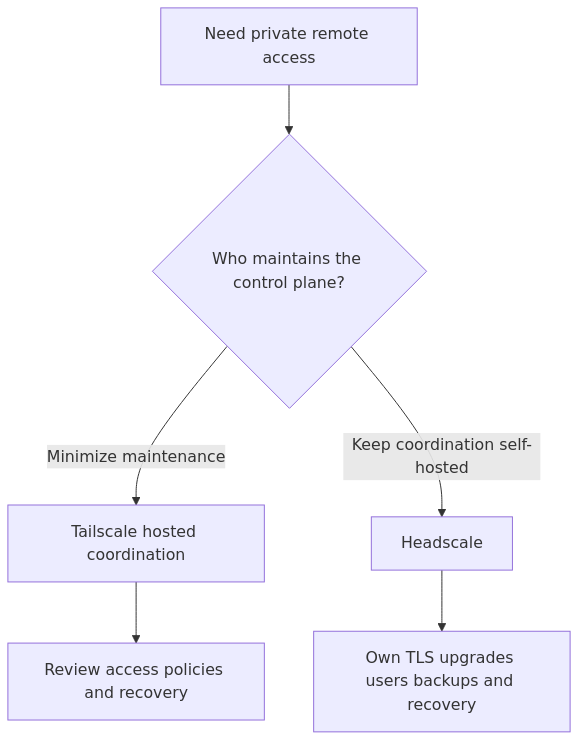
Decision flow for comparing managed and self-hosted control-plane responsibilities.
Headscale and Tailscale solve a similar coordination problem, but they place control-plane ownership in different hands. The practical choice is therefore about administration, dependency, access policy, and recovery - not just feature checklists.
Use the smallest control plane that meets the access requirement and that can be maintained, upgraded, backed up, and recovered by the people responsible for the homelab.
Key Takeaways
Choose Tailscale when a managed control plane and faster onboarding outweigh vendor dependency.
Choose Headscale when self-hosting the coordination layer is an explicit operational requirement.
Evaluate upgrades, identity, ACLs, backups, and failure recovery before deciding.
The 30-second recommendation
The practical answer is in each common scenario:
You want secure remote access with the least maintenance: pick Tailscale.
You want a self-hosted control plane and you are comfortable operating it: pick Headscale.
You need to support several users and devices with the least friction: pick Tailscale.
You care deeply about minimizing dependence on a vendor-managed coordination layer: pick Headscale.
You are still deciding between VPN-style access and public app publishing: stop here and read Cloudflare Tunnel vs Port Forwarding vs VPN first, because that is the bigger architectural decision.
What is actually different here?
This comparison gets sloppy fast if you describe Headscale as "self-hosted Tailscale" and stop there.
The cleaner explanation is this:
Tailscale gives you the clients, the mesh model, and the hosted control plane.
Headscale is an open source, self-hosted implementation of the Tailscale control server.
The encrypted traffic still uses the Tailscale client model and WireGuard-based transport. The decision is mostly about who runs the coordination layer and what that does to your day-to-day operations.
According to the Headscale docs and README, the project is designed as a self-hosted alternative to the Tailscale control server with a narrow scope suitable for personal use or a small organization. That matters because it tells you what Headscale is trying to be - and what it is not trying to be.
If you just want secure access from your phone and laptop to your Proxmox node, NAS, and Docker host, Tailscale solves that with less work. If you want those same clients and workflows but you do not want the hosted coordination service in the middle, Headscale is the path.
Comparison table
transmission signup
article_topic // Headscale vs Tailscale for Homelabs
Don't leave without the setup notes.
Get practical homelab guides, failure logs, and beginner-friendly build notes in your inbox.
Enter your email address to receive the Homelab Addiction newsletter.
Weekly only. No spam. Unsubscribe anytime.
Criteria
Tailscale
Headscale
Best fit
Most homelabs
Privacy-first and self-hosting-first homelabs
Control plane
Hosted by Tailscale
Self-hosted by you
Client experience
Easiest
Similar client model, more backend work
Setup speed
Fastest
Slower and more fragile
Ongoing maintenance
Low
Medium to high
Feature depth
Richer, especially around admin features
Narrower scope
Default support path
Official hosted service and docs
Community/project docs and self-support
Tailnet scope
Broad and polished
Single-tailnet focus per project design
Upgrade burden
Low from the operator side
Yours to schedule, test, and recover
Best default winner
Yes
Only if control-plane ownership matters enough
My evaluation framework
I am not treating this as a pure ideology argument. I am scoring both options against the things that matter once a homelab has to stay usable over time:
1. How fast can you get it working cleanly?
2. How much infrastructure do you have to own and babysit?
3. How good is the admin experience after the first setup day?
4. How much vendor dependence are you actually removing?
5. How much complexity are you adding in exchange for that control?
6. Will this still feel like a good trade six months from now?
That last question matters more than people admit. A lot of self-hosting decisions sound noble at the whiteboard stage and become annoying the minute you are debugging certificates, reverse proxy behavior, or upgrade sequencing on a Saturday night.
Tailscale: the better default for most homelabs
Tailscale wins this comparison because it removes the largest source of pain: the control plane is already there, already maintained, and already integrated into the rest of the product.
That has a practical impact on almost every part of the experience.
Where Tailscale wins
Faster deployment - install the client, authenticate the devices, and you are usually done.
Lower admin overhead - you are not building and securing another internet-reachable service just to coordinate your mesh.
Richer platform features - the hosted product includes polished admin workflows, policy management, and optional features like Tailscale SSH and Tailscale Funnel.
Less upgrade anxiety - you are not responsible for sequencing control-plane upgrades, testing breakage, and recovering from mistakes.
Better fit for family or small-team use - the minute you go beyond "just me and two servers," convenience starts to matter a lot more.
The Tailscale pricing page also makes the trade clearer than many self-hosters expect. The free personal tier is generous enough that a lot of homelabs are not paying cash for the convenience they are about to give up. They are trading convenience away because the idea of self-hosting sounds cleaner.
Sometimes that is still the right call. But it should be an informed trade, not an automatic one.
Where Tailscale falls short
You are depending on a vendor-managed coordination layer.
If you have strict privacy or sovereignty requirements, that dependency may be the whole problem.
If your homelab exists partly to reduce reliance on third-party control planes, the hosted model may feel like an unresolved compromise.
That is the real case for Headscale. It is not that Tailscale is weak. It is that Tailscale is intentionally not self-hosted at the control plane.
Best fit for Tailscale
Pick Tailscale if:
you want secure remote access with the fewest moving parts
you are supporting a growing list of devices and users
you do not want another public-facing service to maintain
you care more about reliability and ease than about complete control-plane ownership
For most readers, this is the winner.
Headscale: the right choice when you truly want to own the control plane
Headscale is appealing for a reason. It solves the part of the Tailscale stack that privacy-first self-hosters dislike most: the hosted coordination service.
The official Headscale docs describe it as an open source, self-hosted implementation of the Tailscale control server, and the project README says the design goal is a narrow, self-hosted alternative suitable for a single tailnet.
That is a strong fit for a certain type of homelabber.
Where Headscale wins
You own the control plane - that is the whole point, and for some labs it matters a lot.
Same general client-side model - you still get the familiar Tailscale-style client experience on devices.
Strong self-hosting alignment - if your lab philosophy is "host the important bits yourself," Headscale makes that philosophy consistent.
Good fit for modest personal labs - the project explicitly targets self-hosters and hobbyists.
There are also a few operational details in the Headscale docs that will appeal to the right audience:
the project recommends SQLite as the default database for its typical use cases
the FAQ notes that Headscale, by default, instructs clients to disable submission to Tailscale's central log service after they successfully connect
the release cadence is active, with current releases visible on the GitHub releases page
Those are not magic bullets, but they are meaningful if your objection to Tailscale is specifically about hosted coordination and metadata posture.
Where Headscale gets expensive operationally
This is the part that many lightweight "just self-host it" takes skip.
Headscale is not enterprise software and is aimed at homelabbers and self-hosters.
Performance is not the primary project focus.
The project does not officially support Docker deployments even though container images exist.
The recommended upgrade path is sequential between stable minor releases, without skipping them.
That is a very honest project stance, and I appreciate it. But operationally, it means you are taking responsibility for:
the public endpoint and TLS setup
reverse proxy decisions and edge behavior
version management and upgrade testing
backup and restore of the control-plane state
support and troubleshooting when something behaves oddly
A public tutorial like the OneUptime Ubuntu guide shows the shape of that work clearly: you need a public-facing server, a domain, reachable ports 80 and 443, and the surrounding service glue. That is not terrible work. It is just very different from clicking through Tailscale.
Best fit for Headscale
Pick Headscale if:
self-hosting the coordination layer is a real requirement, not a vague preference
you are comfortable operating another internet-facing service
you have a modest homelab and understand the project's single-tailnet positioning
you are willing to trade some convenience and polish for ownership
you want the Tailscale client model but not the hosted control server
From the lab
The biggest mistake people make in this comparison
The most common mistake is assuming Headscale is the automatic "advanced user upgrade" from Tailscale.
That assumption is not supported by the documented trade-off.
Headscale is the right move only if the thing you gain - control-plane ownership - matters more than the things you lose or complicate:
simpler setup
lower maintenance
cleaner support path
richer hosted-service ergonomics
If your real problem is that you just want private remote access to work cleanly, Tailscale already solves that. In many homelabs, replacing it with Headscale does not solve a real pain point. It just replaces a philosophical discomfort with operational chores.
That can still be a valid trade. But it should be described honestly.
Which one should you choose by scenario?
1. Solo homelab operator who wants low-friction remote access
Pick: Tailscale
This is the easiest call in the article. You will get to a working result faster and keep it working with less background effort.
2. Privacy-first self-hoster who wants to own the coordination layer
Pick: Headscale
If the hosted control plane is the sticking point, Headscale is exactly the adjacent tool you should evaluate.
3. Family or small-team access with the least admin work
Pick: Tailscale
This is where convenience compounds. More users means more reasons to prefer the product with less backend maintenance.
4. Lab builder who enjoys operating their own control systems
Pick: Headscale
Some homelabs exist partly to learn and run the stack yourself. Headscale fits that motivation well as long as you go in with realistic expectations.
5. You are still unsure whether you even need this comparison
Pick: Tailscale first
Start with the lower-friction path. If you later decide the hosted control plane is the actual problem, then migrate with intent instead of starting with the harder version by default.
How this fits the rest of your remote-access design
This article only answers the control-plane ownership question.
You still need to decide what role the remote-access stack plays in the broader homelab:
That is the right order. Decide the access model first, then decide whether Tailscale's control plane is acceptable, and only then decide whether Headscale is worth the extra weight.
Final verdict
For most homelabs, Tailscale wins.
It wins because the operational burden is lower, the feature depth is better, and the thing most people actually need is a secure remote-access solution they will keep using without friction.
Headscale is still a legitimate and interesting choice. But it is the better tool only when the value of self-hosting the control plane is large enough to justify the additional work.
That means the cleanest recommendation is this:
Pick Tailscale if you want the best default experience.
Pick Headscale if control-plane ownership is important enough that you are happy to operate it yourself.
If you are asking which one an operator would recommend to most HomelabAddiction readers, it is Tailscale - and not by a small margin.
Frequently Asked Questions
Is Headscale a full replacement for Tailscale?
Not exactly. Headscale is a self-hosted implementation of the Tailscale control server, but the operational experience, support path, and scope are not identical to Tailscale's hosted product.
Who should choose Headscale over Tailscale?
Choose Headscale if self-hosting the control plane is a real requirement and you are comfortable operating the extra infrastructure that comes with it.
Is Tailscale still the best default for most homelabs?
Yes. For most homelabbers, Tailscale is still the better default because it is easier to deploy, easier to maintain, and rich enough that the hosted control plane tradeoff is usually worth it.
Does Headscale remove the WireGuard data plane?
No. The comparison is mostly about the control plane. Headscale self-hosts the coordination layer, while the encrypted client traffic still follows the Tailscale client model and WireGuard-based transport.